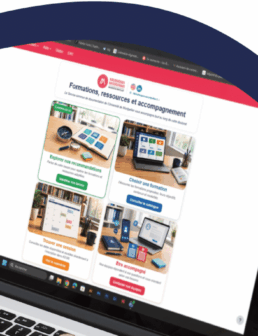
At the end of 2019, the University of Montpellier aligned itself with national policy and implemented its plan for reproducible science. Led by the university's Vice President for Open Science and Research Data, this plan was made possible by collaboration between numerous cross-functional departments and divisions, such as: the Common Documentation Service (SCD), the Montpellier Scientific Data Institute (ISDM), the Innovation and Partnerships Department (DIPA), the Research and Doctoral Studies Department (DRED), the IT and Digital Services Department (DSIN), the archivist, and the Data Protection Officer (DPO).

In practice, this is a comprehensive approach that aims to establish the use of HAL and responsible management of research data. This approach includes various training courses, a university degree in Scientific Data Management, and a wide range of webinars on key Open Science topics: HAL, Open Data, Open Access, digital identity, and electronic laboratory notebooks. 

Support teams, specialized services, and other specific tools are deployed to provide the best possible support in managing data, source codes, and software, as well as in managing digital identity and scientific publications

For scientific publications

Opening of the HAL-UM portal (2017)

Establishment of a network of HAL representatives within UM research units

Funding for the Directory of Open Access Journals (DOAJ)

Peer Community In (PCI) funding

Implementation of the UM scientific publication signature charter

Establishment of a HAL deposit assistance team – Contact the Open Science and Research Support team at the SCD

For research data

Data workshop, towards a research data ecosystem (ECODOR)

Creation of a UM Data Management Plan (DMP) template

UMontpellier Data institutional space on Recherche Data Gouv – RDG UM email

Establishment of a network of data correspondents within UM research units

ISDM-MESO storage and high-performance computing offering 

Implementation of an electronic lab notebook solution

In order to best support national and international commitments to Open Science, the University of Montpellier is heavily involved in large-scale initiatives.


Open Science What is it?

Open Science is the unhindered dissemination of scientific research results, methods, and products. It leverages digital technology to promote access to research publications, data, software, and source codes, with the aim of making research more reproducible. It also encompasses other important aspects:

Scope of Open Science

In France, its implementation focuses mainly on Open Access and Open Data and is based in particular on the Law for a Digital Republic (2016) and the National Open Science Plan (2021-2024).

Open Access in brief

This international movement, which began in the 1990s, aims to make scientific publications freely and openly accessible to readers. To achieve this, two approaches have been identified: open archives (online repositories where researchers can deposit their scientific output) and open access journals (scientific journals with different business models).

More information: toolkit and services

Open Data in a nutshell

Complementing Open Access, the Open Data movement imposes a principle of default openness for public data. Applied to research data, its aim is to improve data management and make data easier to find, accessible, interoperable, and reusable (FAIR principles).

For more information: 

Website Open Science by the Ministry of Higher Education, Research, and Innovation

Data, source codes & software page


CONTACTS

The Joint Documentation Service (SCD) – Contact the SCD's Open Science and Research Support team

Montpellier Scientific Data Institute (ISDM) – ISDM email

The Innovation and Partnerships Department (DIPA) – DIPA email

The Information Technology and Digital Services Department (DSIN) – DSIN email

Archivist (DCSPH) – Archivist email

The Data Protection Officer (DPO) – DPO email

The Directorate of Research and Doctoral Studies (DRED) – SPIL DRED email


News